
Oando Expands Electric Bus Development in Lagos with State Partnership
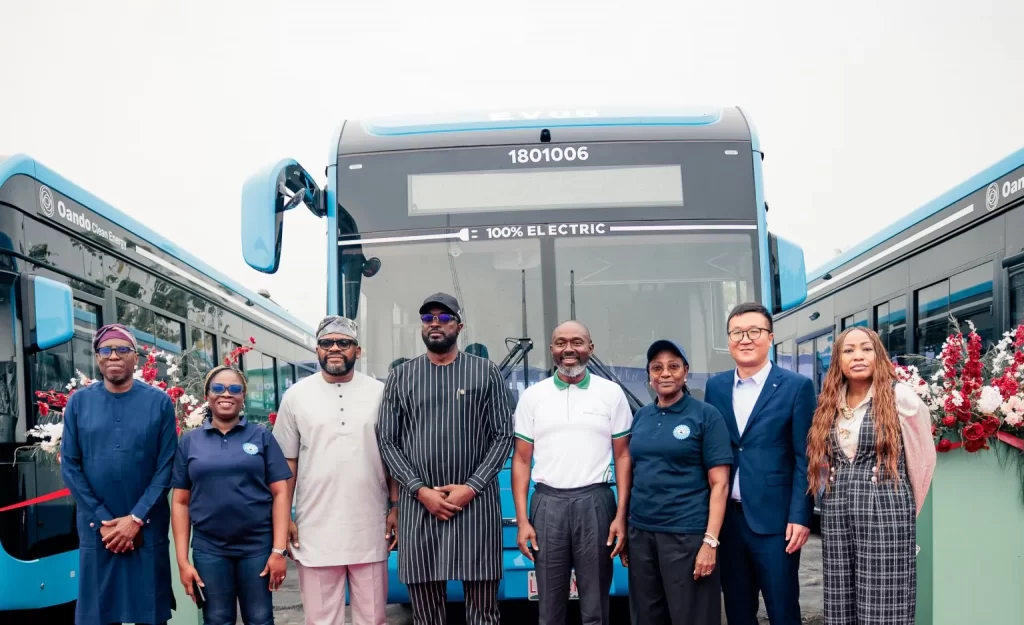
Oando Clean Energy Limited (OCEL) has commenced a wider deployment of electric buses in Lagos in partnership with the Lagos State Government, moving its electric mass transit project beyond its initial two-bus pilot phase.
The rollout was launched on November 10, 2026, at the Lagos Metropolitan Area Transport Authority (LAMATA) Place. It follows the completion of a proof-of-concept programme involving two electric buses operated in partnership with LAMATA.
According to Oando Clean Energy, the initial buses have carried approximately 788,000 passengers and covered 433,000 kilometres since deployment. The company also reported that the buses helped avoid an estimated 216,000 litres of diesel consumption, with close to zero downtime.
In the first nine months of 2026 alone, the service recorded more than 212,000 passenger journeys, with an average capacity utilisation of 73 per cent.
The expansion is part of Oando’s efforts to support the adoption of electric mobility in Nigeria’s public transportation system. Speaking at the launch, Lagos State Commissioner for Transportation, Oluwaseun Osiyemi, said the initiative supports the state’s target of achieving net-zero emissions by 2050. He described the rollout as part of efforts to reduce transport-related emissions, improve air quality and strengthen public transportation.
LAMATA Managing Director, Abimbola Akinajo, said the operating data gathered from more than two years of the pilot programme would help guide the next phase. She noted that the project’s success should be measured not only by the number of electric buses introduced but also by service quality and their impact on commuters.
Beyond deploying buses, Oando Clean Energy says it is developing a wider electric mobility ecosystem to support the project. This includes charging infrastructure, after-sales services, technical training, spare parts supply and local vehicle assembly. The company also disclosed that it has secured a licence for local vehicle assembly, although details of the planned assembly operations were not provided.
Yutong West Africa, the bus manufacturer involved in the project, is expected to support charging operations, after-sales services, mechanic training and spare parts supply.
The new buses come with features including air conditioning, onboard Wi-Fi, 360-degree cameras, wheelchair access and priority seating for elderly passengers. Each bus can accommodate up to 79 passengers, comprising 39 seated passengers and 40 standing passengers.
The buses are expected to enter service in the fourth quarter of 2026, with LAMATA operating them on behalf of the Lagos State Government. The Bank of Industry also expressed support for the initiative, describing investment in cleaner and more reliable mass transit as important to economic activity and public welfare.
While the expansion represents another development in Lagos’ electric mobility plans, its long-term impact will depend on reliable charging infrastructure, maintenance support, spare parts availability and the quality of service delivered to commuters.
As the new buses prepare to enter service, the project will provide another opportunity to assess how electric vehicles can support public transportation and reduce dependence on diesel-powered buses in Nigeria.