
Nigeria’s Power Crisis Is Killing Business Growth — Why Smart Companies Are Going Off-Grid
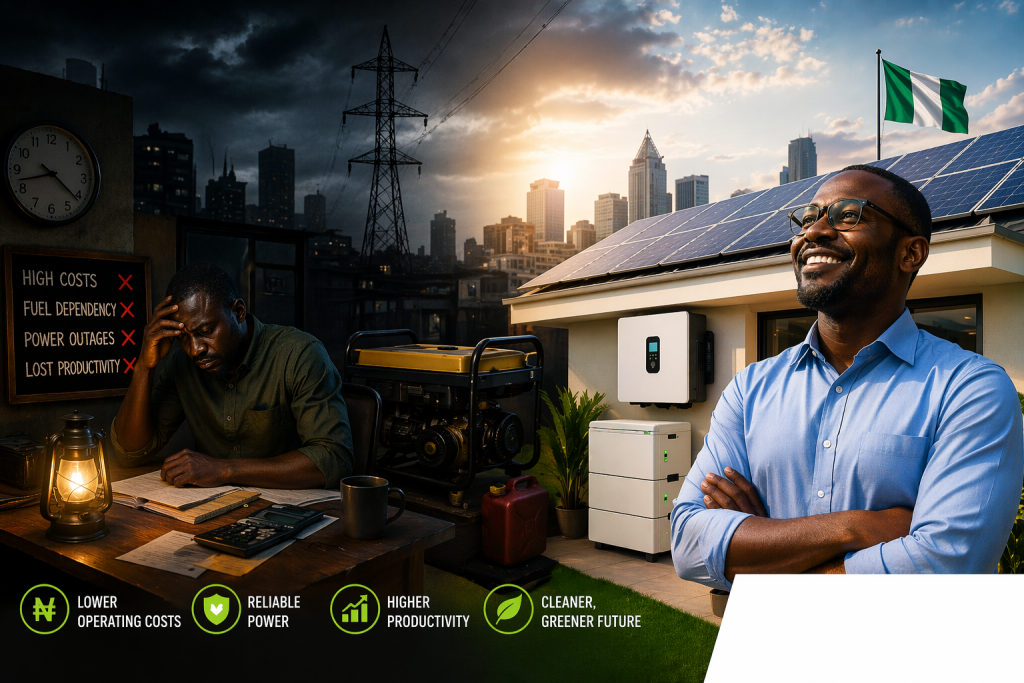
Nigeria has long been a nation plagued by darkness, incompetence, and sheer anyhowness, where darkness feels more reliable than electricity. The nation’s economy and productivity has been stalled by the government’s continued failure to fix the power sector, or better still, hand it over to capable hands in the private sector.
Reports reveal that the privatisation of the National Electric Power Authority (NEPA) in 2005 was fraught with corruption and seeming backhand deals.
In 2020, Joe Ajaero, the current National President of the Nigerian Labour Congress (NLC), said the power sector was not privatised but was balkanised into the hands of government cronies.
Ajaero said, “10 years before privatisation, the government did not spend anything to shore up NEPA, which was producing 4,000Mw; inefficient but low tariff.
“However, in five years, after privatisation, the government had given them N1.7 trillion, and at one time was subsidising with N1.7 billion daily.
“This is a sector that is stuck at that same megawatts, but has increased tariff five times.”
Bolaji Balogun, CEO of Chapel Hill Denham, one of Nigeria’s leading investment banking, securities trading, and investment management firms, disclosed that the privatisation process was programmed to fail from the outset.
Decades of Darkness
Blackouts are the daily reality for millions of homes, businesses, schools, and hospitals, and not an occasional disruption. The lights go out without warning. Productive man-hours are wasted as citizens wait for power to be restored, which may take days, weeks or even months.
But the dark days aren’t new. It’s an age-long experience spanning decades. Before the advent of rechargeable lamps, there were torchlights. And when households couldn’t afford torchlights, they used kerosene-powered lanterns or candles. Children read books this way, and families slept through the night in darkness.
And at the core of this is a sector crippled by debt, repeated grid collapses, and a leadership that has failed to turn promises into progress. This has gone beyond merely an infrastructure problem. It is a national crisis.
A Sector Buried in Debt
Nigeria’s electricity sector is drowning in a mountain of unpaid obligations. Debts owed to Generation Companies (GenCos) and Distribution Companies (DisCos) have continued to pile up, creating a dangerous chain reaction across the energy value chain. This hampers the ability of GenCos to meet obligations to gas suppliers. And when gas supply drops, power generation falls. Then this leads to the inevitable: the grid collapses.
Debt at the top becomes darkness at the bottom.
The Chief Executive Officer of the Association of Power Generation Companies, Joy Ogaji, said the gas companies informed the GenCos that they would no longer supply gas to thermal plants unless payments were made.
Apologising for the erratic power supply two weeks ago at a press conference in Abuja, Nigeria’s Minister of Power Adebayo Adelabu said, “I want to apologise to Nigerians, officially now, coming from me as the minister of power, for this temporary issue that is leading to hardship being experienced, especially during this dry season, where there is so much heat everywhere.
“Businesses are being affected, schools have been affected, and industries have been affected. It is not our wish to find ourselves in this situation, but it is due to some factors that are actually beyond our control.”
“I can tell you, with the committee that we have set up, commitments from gas suppliers, and the timeline for the repair of the gas pipelines, two weeks from now, we should start seeing improvements in supply. Two weeks!” Adelabu stressed.
Speaking on the power issue, Bayo Onanuga, Special Adviser to the President on Information and Strategy, said in a statement dated April 05, 2026, that, “the debt repayment plan followed the final review of the legacy debts that have beset the power sector for more than a decade.
“The long-standing debts accumulated between February 2015 and March 2025. Following verification, ₦3.3 trillion has been agreed as a full and final settlement, ensuring a fair and transparent resolution.”
Two years ago, Adelabu declared at the 8th Africa Energy Marketplace in Abuja that the government was prepared to clear its outstanding debts.
“The N1.3 trillion debt to power-generating companies would be paid via cash injections and promissory notes, while about $1.3 billion owed to gas companies will be paid via cash and future royalties,” he said.
He added, “For the power generation companies, the debt is about N1.3 trillion, and I can also tell you that we have the consent of the President to pay, on condition that the actual figures are reconciled between the government and the companies.
“This we have successfully done, and it is being signed off by both parties now. The majority has signed off, and we are engaging to ensure that we have 100 per cent sign-off.
“The debt will be paid in two ways: immediate cash injection and through a guaranteed debt instrument, preferably a promissory note. This assures the companies that in the next three to five years, the government is ready to defray these debts.”
Endless Blackouts, Endless Excuses
The national grid collapses almost every market day, plunging cities and communities into darkness. These repeated incidents are unacceptable for a country of over 200 million people. It destroys goods and services and stifles productivity. It literally destroys the economy. Businesses are spending a fortune on diesel and petrol to keep the lights on. These expenses take a significant portion of the projected profits of small enterprises, which have to live in survival mode, instead of focusing on job creation.
Families are paying more for transportation, food preservation and basic comfort. Schools, hospitals and large-scale industries are forced to rely on alternatives.
The cost of darkness is not measured only in naira, but in a declining quality of life, lost opportunities and lost productivity.
Nigerians Have Created Their Own Alternatives
Due to persistent government failure, Nigerians have resorted to what they have always done best — adapt and survive. In homes, offices, religious institutions, schools, and commercial centres, alternative energy sources have been deployed to fill the gap left by the national grid.
On almost every street, it’s sound before sight, as the noise from generators can be heard from a distance, before seeing any. They have become almost as common as refrigerators. The familiar sound of “I better pass my neighbour” machines and industrial diesel generators now forms part of the soundtrack of daily life. A disturbing trend that has far-reaching and long-standing effects on the quality of human life and on the environment.
At the same time, many businesses and households have begun investing in solar systems, inverters, and adequate battery storage solutions to guarantee uninterrupted power. This investment isn’t born out of luxury; it’s for survival, born out of necessity.
To put this in proper context: Nigerians are privately funding what should ordinarily be a basic public utility.
The Generator Trap: Expensive and Exhausting
Generators have not only been a stopgap, but they have also served as a lifeline. However, they have also become a major source of concern and frustration.
Another trap often overlooked with the use of generators is the unpredictable nature of petrol and diesel costs. At the beginning of the year, petrol sold for an average price below 800 naira for a litre. It currently sells at a rate 60 to 70 per cent higher. This increment has huge implications for many families running a generator for just a few hours daily, as it consumes a significant part of their monthly income.
For businesses, especially SMEs, the burden is even worse. Coupled with high maintenance costs, profit margins are being eaten up by fuel expenses, as money that should be spent reinvesting in growth is instead being spent heavily just to keep the lights on.
This has led to a price increase of goods and services, as businesses transfer the cost to consumers, which, invariably drives inflation.
The Environmental Cost of Darkness
Beyond the economic pain, the widespread use of fuel-powered generators has created a serious environmental problem. It contributes significantly to air pollution and carbon emissions from generators, worsens environmental degradation and contributes to climate change.
In many neighbourhoods, aside from the obvious issue of noise pollution, residents breathe in toxic fumes daily, which are also hazardous to human health. Many people have died after inhaling these fumes.
Aso Rock To Go Off-grid
Last year, the Presidency said it planned to leave the national grid by March 2026, in a bid to transition the complex to an independent solar power system.
The State House Permanent Secretary, Temitope Fashedemi, who disclosed this while defending the 2026 budget proposal of the State House before the Senate Committee on Special Duties at the National Assembly, said “since May last year, the generator at the Medical Centre has not been switched on for one minute,” adding that only about three per cent of its energy needs were briefly supplemented from AEDC in the early months of the transition.
This decision from the President’s home is a clear indication of the government’s policy direction on electricity, and any keen observer will read the room and act accordingly.
Why Solar Is the Best Way Forward
Amid this crisis, solar energy stands out as the most sustainable and reliable alternative. Unlike generators, they provide cleaner energy without the repeated burden of fuel purchase. They offer long-term cost savings, a stable power supply, and minimal environmental impact once installed.
When paired with inverters and adequate battery storage, they can power homes and businesses for extended periods, reducing dependence on the fragile national grid, thereby providing sustained power in a way that generators simply cannot. With Nigeria’s abundant sunlight year-round, solar energy is no longer a nice-to-have; it is a must-have.
This is why you need a forward-thinking Engineering, Procurement, and Construction company like Revocube Energies, which helps homes, businesses, schools, and institutions take back control of their power supply.
By delivering reliable and dependable solar and inverter solutions tailored to Nigeria’s energy realities, the company offers a practical alternative to endless blackouts, rising diesel costs, and the environmental burden of fuel-powered generators. Just like Aso Rock, which plans on detaching from the grid, more Nigerian homes and businesses are choosing smarter, cleaner, and more reliable energy systems that guarantee peace of mind, because the future of power in the country may not come solely from the grid.
It would come from the rooftops of homes, the offices of growing businesses, and the strategic energy choices made today. For those tired of living at the mercy of blackout schedules and broken promises, solar is no longer just an option. It is the way forward.
And with trusted providers like Revocube Energies leading the transition, that future is already within reach. Are you ready to make the switch to renewable energy, or do you need an energy audit or a solar system quotation? Contact our expert team via email at info@revocubeenergies.com or via phone on +234 913 968 6844.