
Nigeria Targets Fresh Solar Investment as Africa’s Energy Players Head to Lagos
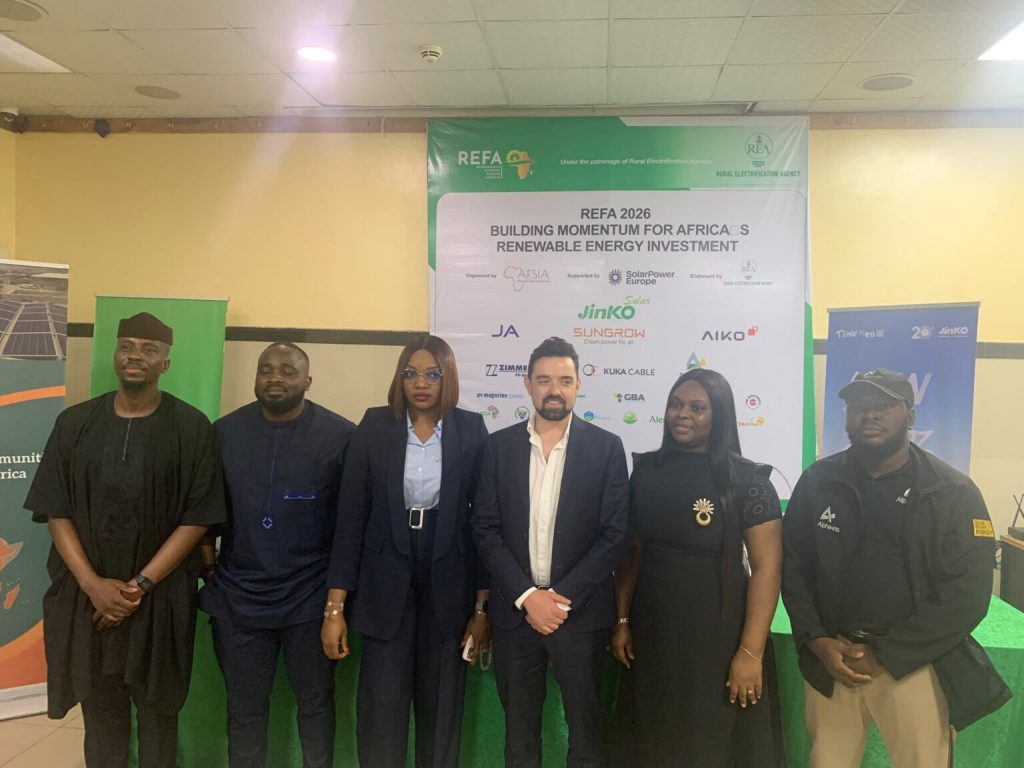
Nigeria is looking to attract more investment into its renewable energy sector as key players in Africa’s solar industry prepare to gather in Lagos for the Renewable Energy Forum Africa (REFA) 2026.
The two-day forum, organised by the Africa Solar Industry Association (AFSIA) with support from SolarPower Europe, will be held on November 25 and 26 at the Radisson Blu Anchorage Hotel, Lagos. It will bring together investors, project developers, manufacturers, policymakers and energy companies to explore opportunities across Africa’s renewable energy market.
The event will take place under the patronage of Nigeria’s Rural Electrification Agency (REA), with its Managing Director, Abba Aliyu, expected to deliver the opening keynote address.
Nigeria’s position as West Africa’s leading solar market is a major part of the investment conversation. Data from AFSIA puts the country’s operational solar capacity at approximately 618 megawatt-peak (MWp), making it the largest in West Africa and eighth-largest in Africa.
The country also leads Africa in mini-grid capacity, with about 132 MWp, while its commercial and industrial solar market has reached approximately 385 MWp. Notably, around 76 per cent of Nigeria’s operational solar capacity was commissioned from 2022 onwards.
Government-backed financing initiatives are also creating opportunities for further growth. The $750 million World Bank-backed Distributed Access through Renewable Energy Scale-up (DARES) programme aims to support the development of 1,350 solar mini-grids and improve electricity access for 17.5 million Nigerians.
In addition, the $300 million Nigeria Distributed Renewable Energy Fund, managed by the Nigeria Sovereign Investment Authority and Africa50, is expected to support mini-grids, standalone solar systems and other distributed energy projects.
Beyond project financing, Nigeria is also looking to strengthen its local solar manufacturing capacity. The country’s first privately owned 100MW solar module assembly plant is already operating in Ibeju-Lekki, Lagos, while the REA, InfraCorp and Solarge are developing plans for a 1GW manufacturing facility.
Regulatory changes are also opening new opportunities. Under NERC’s 2026 Net Billing Regulations, eligible solar customers can export surplus electricity to the grid and receive credits. Meanwhile, electricity market oversight has shifted to 16 states, allowing state regulators to oversee licences and tariffs for projects operating within their jurisdictions.
At REFA 2026, discussions will cover the financing challenges holding back utility-scale renewable projects, the role of energy storage, corporate power purchase agreements and the commercial potential of mini-grids.
The forum will also examine investment structures that can address currency and payment risks, alongside opportunities in electric mobility, solar manufacturing and energy storage.
For Nigeria, the bigger challenge is turning its growing market and investor interest into projects that can secure financing, operate sustainably and deliver reliable electricity to businesses and communities.
As Africa’s renewable energy investors gather in Lagos, the outcome will depend not just on the partnerships formed, but on how effectively those partnerships translate into new capacity and wider electricity access.