
Nigeria Has 13,625 MW of Power Capacity. Why Is Electricity Still Unreliable?
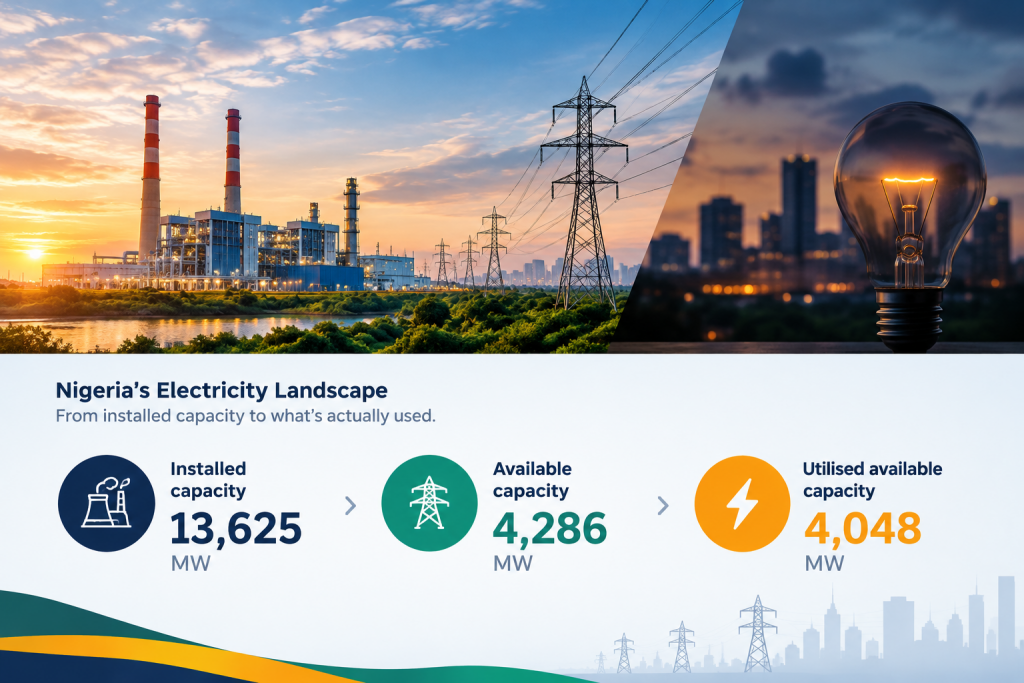
Nigeria has 13,625 MW of installed electricity generation capacity.
So why does the country still struggle to provide reliable electricity to households, businesses and industries?
The answer is buried in the gap between what Nigeria has installed and what its electricity system can actually make available, move and deliver.
In April 2026, only 4,286 MW of Nigeria’s installed grid-connected generation capacity was available on average, according to the Nigerian Electricity Regulatory Commission (NERC). Of that available capacity, 4,048 MW was utilised.
Understanding the Electricity Capacity Gap
To get a better understanding of the electricity value chain, we need to define the following terms:
- Installed capacity: the power plants produce under specified conditions.
- Available capacity: the available generation capacity for dispatch.
- Generation: electricity actually produced.
- Transmission: electricity transported through the transmission network.
- Distribution: electricity delivered to customers through DisCos.
- Load factor: the available capacity actually utilised over the period.
- Plant availability: available capacity relative to installed capacity.
So, having 13,625 MW of installed capacity is like owning 13,625 MW worth of generators. This doesn’t mean all the generators are running, fuelled, connected, healthy and capable of supplying electricity at the same time. So, Nigeria’s electricity problem isn’t a shortage of power plants; it’s a system problem.
The Electricity Value Chain: Where Does the Problem Begin?
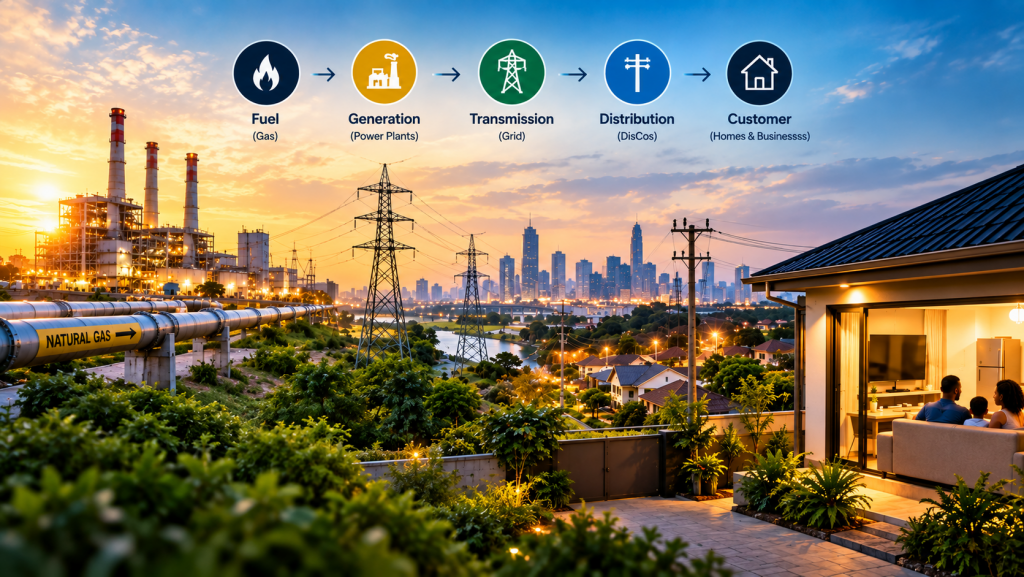
We could break the system into:
Fuel → Generation → Transmission → Distribution → Customer.
If anything fails at any level, the entire system is compromised.
At the fuelling stage, gas plays a pivotal role; however, several things could go wrong, such as insufficient gas supply, gas infrastructure constraints, and commercial or liquidity issues affecting gas supply. The generation stage could face feedstock constraints, ageing infrastructure, low availability, plant maintenance and possible mechanical failures.
The transmission stage faces grid collapse, network constraints and the inability to move all available generation, while the distribution stage battles network constraints, overloaded infrastructure, technical/commercial losses, and the inability to deliver power reliably to customers.
The 13,625 MW Installed Capacity Doesn’t Tell the Whole Story
The NERC April 2026 data revealed that for every 100 MW of installed grid-connected generation capacity, only about 31 MW was available on average, meaning 69% of installed capacity was unavailable during the month.
But that’s not all. The load factor shows that 94 per cent of the available capacity was utilised. So, there’s a large portion of installed capacity that’s unavailable in the first place; however, what was available was used heavily.
Installed capacity is the combined accumulation of plants. It can include plants that operate below rated capacity, are undergoing maintenance, are constrained by fuel availability, are mechanically unavailable, are commercially constrained, are technically constrained, or otherwise cannot deliver their nominal output.
Nigeria’s Generation Fleet Has a Persistent Availability Problem
NERC’s 2024 annual report recorded an average availability factor of only 37.43% for grid-connected plants, while 2025 recorded an average availability factor of 39.62%.
These figures point to a persistent gap between what Nigeria generates on paper and what is actually available for use.
The issue, therefore, is not simply how much generation capacity exists, but how consistently that capacity can operate.
Should Nigeria Simply Build More Power Plants?
The obvious — and lazy — response to a 13,625 MW versus 4,286 MW gap is, “Then Nigeria needs to build more power plants.”
But the data raises a more fundamental question: What is the point of adding generation capacity if existing capacity can’t operate consistently and the rest of the electricity system cannot reliably move and deliver the power?
This question doesn’t disregard the need for more generation; it means additional generation should be accompanied by improvements across the electricity value chain.
Not All Power Plants Are Performing the Same Way
NERC’s April data show considerable performance differences between plants. For example, Ikeja 1 and Ihovbor 2 had very high availability of 100% and 99.6%, respectively; Olorunsogo 2 had only about 4%, and some plants — Alaoji 1, Ibom Power 1, and Rivers 1 — recorded zero availability during the period.
Some plants are performing well. Others aren’t.
The question is why?
Possible factors include maintenance, fuel availability, plant condition, commercial issues and other operational constraints.
Gas: The Fuel Behind Nigeria’s Power Generation
Nigeria cannot power its electricity plants effectively and efficiently without gas, as a significant portion of its grid-connected generation fleet is gas-fired, so generation is closely connected to gas availability and economics.
According to the Nigerian Upstream Petroleum Regulatory Commission (NUPRC), the nation’s daily gas production rose to 7.93 bcf, while domestic sales hit 2.18 bcf/d in May.
The data show that local utilisation accounted for 27.49% of total production, while export sales stood at 38.71%. The outlook is worrisome; domestic usage falls behind, and raises doubts about whether Nigerian power plants can reliably obtain the gas they need at commercially viable prices.
From Generation to the Grid: Why Available Power Isn’t Automatically Delivered
The numbers show that Nigeria’s electricity challenge is increasingly a question of system performance — not simply installed generation capacity.
Think of the system as:
Generation = producing the water.
Transmission = moving the water through the main pipes.
Distribution = getting it through neighbourhood pipes.
Customer = turning on the tap.
Although 4,286 MW was available for dispatch, 4,048 MW of that available capacity was utilised. Electricity still had to pass through the transmission and distribution networks before reaching consumers.
The Cost of an Unreliable Electricity System
To put this in proper perspective, this structural problem has dire consequences for households, businesses, and industries.
Households grapple with unreliable power supply, dependence on generators, high energy costs, and the need to seek alternative sources, which usually don’t come cheap. Businesses are burdened with spending large sums on diesel and petrol, generator maintenance, downtime, high operating costs and the need to invest heavily in solar systems with huge battery storage capacity. Industries struggle with production reliability, energy-intensive operations, competitiveness, and key investment decisions.
Nigeria Needs a Complete Electricity System Overhaul
There’s no quick fix for the electricity challenges the nation is plagued with.
However, there’s a need to embark on a complete system overhaul that considers the importance of gas in the entire value chain, the need to improve on generation capacity, ensuring that the transmission lines and networks are working optimally, while the distribution network is upgraded to meet the nation’s current and future demand.
Adopting a more aggressive decentralised energy system across the country, coupled with massive storage capacity, could also support greater resilience and reliability.
Nigeria Doesn’t Just Need More Megawatts
Nigeria’s electricity challenge is ultimately bigger than the headline number of installed capacity.
The country needs to address the gap between installed capacity, available capacity, generation, transmission, distribution and actual customer supply.
More generation capacity remains important. But it needs reliable gas supply, functioning generation assets, stronger transmission infrastructure, more capable distribution networks, adequate storage and economically sustainable energy systems.
Nigeria doesn’t merely need more megawatts. It needs more usable, reliable and economically deliverable megawatts.