
4 Important Questions to Ask an Installer Before Getting a Solar System
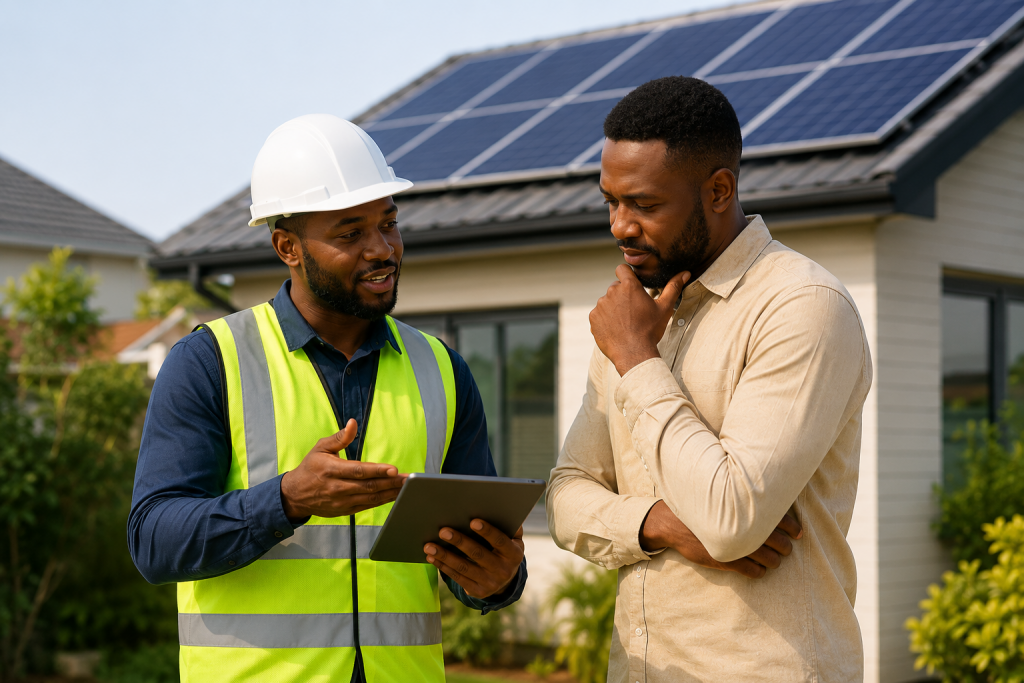
Buying a solar system is a big investment, whether it’s for your home or your business. Before you sign any agreement, here are four questions you must ask and what the right answers should sound like.
1. System Sizing and Energy Needs
What size of solar system do you recommend, and why?
A good installer will not just quote you a size. They will explain the size based on your actual power needs.
Did you base this on a detailed energy audit of my daily power use and appliances?
This is the difference between a system that works and one that disappoints you. An installer should look at what you use power for fridge, AC, pumping machine, office equipment before recommending anything.
Will this system support future expansion if I need to add more appliances or a backup battery later? Your power needs may grow; therefore, an installer should factor this possibility from the get-go.
2. Installation and Costs
Do you use in-house installation crews or subcontractors?
In-house teams are easier to hold accountable. Subcontractors can mean less consistency and a slower response if something goes wrong.
Is the final quote all-inclusive, covering delivery, mounting frames, protective breakers, configuration, etc?
Some installers quote low, then add “hidden” costs later. Ask for one final number that covers everything, not just the panels, inverters and batteries.
What permits or local regulations must be handled, and do you handle that paperwork?
Depending on your location, some installations need approvals. A serious installer should handle this for you, not leave you to sort it out.
3. Warranties and Support
What are the manufacturer warranties on the panels, inverter, and batteries?
Every major component should have its own warranty. Panels usually last the longest; batteries and inverters may have shorter coverage. It’s important to know the numbers.
What does your workmanship or installation warranty cover, and how long does it last?
This is separate from the manufacturer’s warranty. It protects you if the installation itself, not the equipment, was done wrong.
Who do I call if the system stops working, and what is your average response time?
Get a direct answer here, not a vague promise. A system that breaks down with no fast support defeats the purpose of going solar.
4. Equipment Quality and Brands
What specific brand, model, and wattage of solar panels will you install?
Don’t accept “quality panels” as an answer. Get the exact brand and model so you can verify it yourself.
What make and model is the inverter, and is it properly sized to handle the DC power output from the panels?
An undersized inverter limits your system’s performance, no matter how good the panels are. Confirm the numbers match.
If batteries are included, ask for their capacity, make, and storage limits.
This determines how long you can run on stored power, especially at night or during outages.
Are your products certified to IEC (International Electrotechnical Commission) standards to prevent low-quality or counterfeit hardware?
Certification is your proof that the equipment meets recognised safety and performance standards, not just a sales pitch.
Ask these four questions before you commit, and you protect yourself from bad installers and investment.